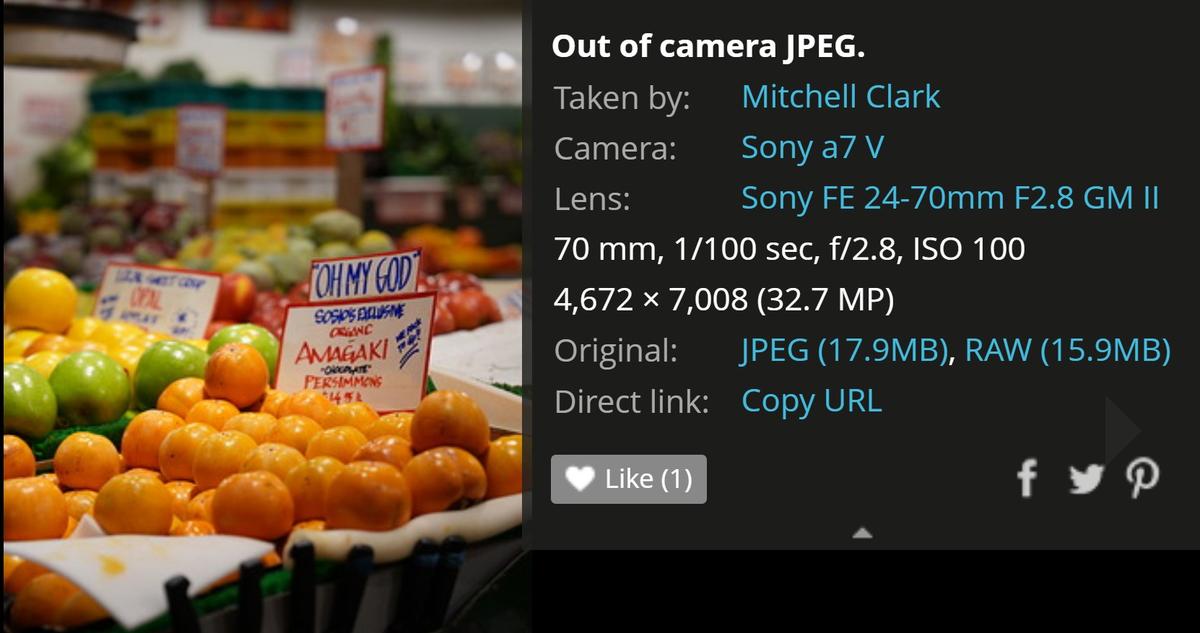
The other forums im on are totally against reality, they are trying to sell mutton as lamb, the new sony a7v has been so hiped up that it shoots 16 stops of DR which is total nonsence, then bill totally stuffs up his findings and then comments that he doesnt know what hes doing and retracts his findings to coenside with sony 🤔🤨Tony N makes a utube with a direct comparrision totally different to bills final figures and totally doesnt want to trash the new sensor even though he shows how crap it is during the vid. its a total circus, and im loving it because im saying the new FF sensor is no better than the a6700 in speed or image quality. Talk about get eggs thrown at me for stateing the obvious 😁 a mod then sends me a PM telling me to keep my mouth shut or i will stay on moderation 😊reminds me of the good old days 🥳
Is the new XenForo DPR acceptable?
- 14 votes.
- Voting ends on Nov. 8, 2025.
- Votes are public.
- Started by xpatUSA on Nov. 7, 2025.
-

-
Don,
Just relax and let the get on with it.
-
Its all good, ive just busted the myths about 16 stops. im just going to sit on the side line and watch all the confusion now.
just so much deception with camera specs and testing procedures these days. -
What? I thought that was the main purpose of the forum. Crazy! 😂
-

@A74Me versus @MartinOcando there is quite fun ...
DPR closed the thread ... can't imagine why ... 😉
-
The sony forum is under strict control now, im now supposidly bashing the a7v as well because i think its being marketed with deception, tell me what is totally wrong with the numbers. When is a raw file smaller than a jpeg 🤣 no wonder the a7v has 30 stops of DR 🥳 Sony "we dont ad NR to the raw file" 🤣 my a7iv raws in 14 bit are 70 meg.
-
my a7iv raws in 14 bit are 70 meg.
In their review it says that they now output smaller raw file sizes ...
Battle of the screen crops ...
-
what you have posted is electronic shutter file size, mechanical is half that, because only mechanical is 30 stops and the electronic is 8 stops 🫣 have you figured it out whats happening 🤔
-
no
i measure file size in bytes not stops
-
from my homework when the camera is in mechanical shutter it uses massive NR and the file sizes are very small just like a jpeg , but when the camera is shooting with electronic shutter the file size is much larger but still compressed, no one has any idea yet, but if you look at all the sample galley images taken at DPR you can match the electronic shutter with larger files and the mechanical with smaller files from iso 800 to 100 only ,a guy from reddit made the claim the its measured DR not acutal DR if you measured it via camera exposure stops. Gerrald Undone said hes had enough of testing cameras, they are all fake numbers now.
-

That should get him a few more hits.
Given the lack of hard data, is this going anywhere ?
Me, I'm happy to wait for
1. Real Facts
2. Real World Testing.
3. Real PricingNone of which are coming on the 2025 Sleigh.
-
waiting for Dustin Abbott and CineD , they both havent posted there reviews yet, which is very strange. they are the only real world testers on the net as far as im concerned.
www.youtube.com/watch?v=qFJFonWfBBM&list=RDiX6k9ZEbiKY&index=5 🤔😎 -
Not funny at all:
Update 12/12: Bill Claff at Photons to Photos has revised his Sony a7 V dynamic range results, now determining that the camera is not utilizing baked-in noise reduction but instead achieves its excellent dynamic range thanks to Dual Gain Output.
-

The embedded JPEG in the raw file would have to be low quality, or reduced resolution, whatever the other factors. With Canon raws, the embedded JPEGs are full-res and HQ, so a stand-alone JPEG will never be larger than a raw file from the same exposure. If other manufacturers use low-res, lower-Q embedded JPEGs, then it could be possible, depending on raw bit depth, exposure levels, and compression.
BTW, lossless compression of raw data in cameras is designed for speed, but in any raw where only 5 or 6 bits are actually used in most of the photo, third-party compression can make lossless raws so much smaller than OOC raws. Convert to uncompressed DNG, and apply max compression in something like 7-Zip, and the intelligent compression will see right through the CFA mosaic, and see that the color channels are more compressable than the full mosaic.
I have solutions. Noise should be measured in a spectrum, and if you're only going to report noise at one frequency, make it at a lower frequency than the original pixels. Taking the standard deviation of raw images at the pixel level sets up cooked raws to seem more noiseless than they actually are. Cooked raws use filters with very small radii, usually just softening the contrast between neighbor pixels, which has almost no effect, whatsoever, on the original pixels binned, say, to 4x4. A 4x4 bin is actually a more accurate gauge of image level noise, than the original pixels are. Somehow, high-frequency standard deviations have become a sacred cow in the world of noise metrics, when in fact, that frequency is the most likely to get corrupted in any kind of filtering or resampling, or line-based offset noises (fine horizontal banding noise is still present in modern sensors to various degrees).
Every website that measures noise still has the original raw files, and could add "binned" data, which is actually more related to the visual experience of noise, than pixel-level noise is, especially with higher pixel counts. No new tests would be needed; just a script that re-interprets the original files at a lower frequency which is unaffected by raw cooking.
-
Cheers, thanks for the info. very interesting processes. i have asked a new a7v owner to send me some raw files 1 using electronic and another using mechanical shutter but so far no one has replied and the mod deleted my request to a member. 🤔 personally i have nothing against the a7v process as i have chalenged members to process a raw from my a7iv better than my out of camera jpeg with my in camera settings applied and out of a dozen chalengers no one could untill i posted my jpeg and then 1 guy matched it but could not better it.