How about a diagram, and some maths to back it up?

Dec. 8, 2023
272
-

-
First of all, it wasn't a trick. I simply asked you to explain "what you think observation would show in the following situation." I didn't force you to describe it in terms of pure maths or anything else. I was curious about how you would describe it. It seems that you don't want to describe it at all, except in very vague generalisations, e.g.
Nothing precise there, no mathematical formulas, almost nothing of any practical value to anyone.
I like to give people the benefit of the doubt and give them every opportunity to explain themselves more fully and in more detail if I cannot understand what they say. You have been given every opportunity, but you simply repeat the same vague statements time and again and refuse to go into any more detail, yet you have the temerity to criticise the theory of perspective that has been understood for centuries and claim that it is not possible to explain what we see in a photograph in terms of mathematics.
You claim that you agree with the statements about perspective in the Manual of Photography, but you then proceed to describe perspective in your own fanciful ways that contradict the traditional understanding of perspective.
I guess that you will continue to talk the same old nonsense and continue to claim that what you say is sound science and that I (or anyone else disagreeing with you) am the one talking nonsense. The Donald Trump technique?
-

[deleted]
-
[deleted]
-

@TomAxford Your theories on perspective contradict the traditional view of perspective, they contradict the maths of image geometry, they contradict what is clear by simple observation and they contradict current scientific theory.
You don't even seem to understand the maths of pure geometry to the point that you can't see the world it predicts, or how it differs from the world we see through human eyes. It's not hard to do this, any halfway competent mathematical can do it.
Instead you take an effect where we see distortion in the fixed perspective of a 2D image when we view it through human eyes and insist that it can be explained through pure geometry alone, even though pure geometry predicts something quite different.
You haven't even worked it out that "telephoto compression" and "wide angle distortion" are the true geometries of the respective images. Instead you take the one point when you view an image and don't see that perspective and use that as the point that you see perspective as described by pure geometry.
I've been trying all through this to prompt you to question your base assumptions and question that you are not looking at this whole thing back to front. But no, TomAxford alone has absolute vision and so what he sees is the absolute truth and this relates directly to pure geometry.
Even though that viewpoint even contradicts pure geometry, and everything else noted above.
It's a nonsense question.
FACT: We do not see the world of pure geometry through human eyes. The camera sees it, and we can glimpse it in images but only if we view them from a position outside the centre of perspective. That is the correct way around. And it's pointless discussing anything until you are able to see just a little way beyond your own opinion, even if it's just the true nature of the world that pure geometry predicts.
-
No need to "shout", Tom.
I made no mention of the absolute size of the image. My comment referred only to the relative angular size of the two persons.
-
I'm very sorry, I was not intending to shout, simply trying to be unambiguous and to the point.
I agree that you referred only to the relative size, but you then deduced that there was no difference between the two cases (I assume that is what you meant by "ergo, no difference").
That deduction implied to me that you had assumed that the absolute size was unimportant. Why did you not mention the absolute angular size when it is the main thing that varies when the viewing distance changes?
-

No one - they are independent concepts. That's the whole point if you had actually read what I wrote.
You're doing the same thing - bringing up an unrelated point (that viewing condition can change human perception of an image) to argue something entirely separate, namely that viewing condition changes perspective, which it doesn't. Only the relative position between the camera and the scene can change perspective.
-
Yep, I should have said "no difference between the relative angular size of the two persons in the image in case (1) and case (2) irrespective of the absolute physical size of the viewed image" ... thereby trying to avoid misunderstanding by your good self. Pardon my lack of clarity , folks.
I did not feel that it was a factor in the context of my post.
-
Human vision doesn't maintain relative size and scale when viewing the real world, in terms of human vision it is unimportant.
Because that relationship is not preserved in human vision in the real 3D world it can't be (and isn't) a constant and so is not used in human vision in the way that you envision.
You continue to assume that what you see through your own eyes is absolute and directly equivalent to pure geometry and then apply pure geometry directly to to describe not only what you see, but also provide the explanation of why you see it. And a theory based on such a fundamental error of assumption will turn to mush pretty quickly. Which it does, you contradict known science, simple repeatable observation, even pure geometry and yet fail to notice. I could show you a dozen more images that demonstrate beyond any question that absolute angular size is not preserved in human vision. But it won't make any difference as you will still fail to question your assumptions and still treat the absolute angular size as proven fact. I've raised a reasonable doubt and shown you proof that confirms this doubt, real science would've looked at this objectively, (and did a long while ago).
To everybody else:
Perspective is the distortion of shape caused by a single and unique point of observation, pure geometry dictates that distortion should also be in constant motion relative to movement of the observer. Which it is. This is all obvious if you follow the maths of pure geometry.
But it is a really confusing place for us so we have developed through empirical means a way of cancelling it:
Constancy scaling.
Constancy scaling is a weird but wonderful trait of vision. What this means in practice is that constancy scaling allows us, in the world we see immediately around us and into the middle distance, to subtract that distortion that pure geometry dictates and with it the way shape and relative scale changes as we move. What it allows us is a far more accurate and stable understanding of the true shape and relationships between objects in our immediate environment. Our understanding of the shape of a book, for instance, remains constant no matter what distance or angle you view it. It may be really tempting to relate this directly to pure geometry, only constancy scaling is a proven fact, and it means that your consistent understanding of shape is because the brain is actually altering things like absolute angular size as you move.
It also means that it is impossible to apply pure geometry to human vision because human vision is actively subtracting the effects of pure geometry even as you look at your computer screen reading this. If anybody is actually reading this...
Because pure geometry is relative to distance, constancy scaling is also relative to distance, they wouldn't cancel effectively if they weren't. And so this has an odd effect when we view things out of context, like a photograph of a 3D scene where the relationships are fixed by rendering to a 2D surface and so don't move as we view at different distances.
If you view a photo of a distant object from a distance relative to the camera position (centre of perspective) then you find that constancy scaling has roughly the same effect in both the real world and the photo. But if you stand really close to the image then the brain assumes a closer distance and doesn't apply that constancy scaling, and so you begin to see the true pure geometric perspective as captured by the camera. Do the maths, work out what pure geometry dictates the image should be.
Similarly if you look at a photo of a near object from a distance behind the centre of perspective you brain assumes it is further away and so fails to subtract the distortion caused by viewing at a close distance and again you see something closer to the true pure geometric perspective as captured by the camera. Do the maths, work out what pure geometry dictates the image should be.
Of course the rub is that we learn through experience, and the whole point of constancy scaling is to give us a consistent understanding, so we even learn how to cancel the effect when viewing images. Basically even in images absolute angular size is not preserved.
It also means that mathematically and perceptually Ansel Adams is correct, distortion is primarily and fundamentally a function of camera position, wide angle distortion and telephoto compression are determined by camera position alone as they cannot be reversed by print viewing distance.
-
-
With reference to the highlighted text from Tom's OP: Until you move to a point where the brain finally says hang on, that constancy scaling doesn't describe what I am seeing.
The geometric concept of centre of perspective describes the only TRUE central point of perspective. What the brain does in it's shape and spatial recognition is indeed a good thing so we are not confused by projection. What you are talking about is what the mind perceives. I am quite capable of disconnecting from my constancy scaling and seeing, for example. the trapezoid outlined by my screen because I am not perpendicular to it. Just because my mind knows it is actually a rectangle doesn't mean I can't see it as it is truly projected.
Earlier in the thread Tom posted the pics of the man walking along the train line with a train in the distance. It took a bit of careful observation from up close and far away, but eventually I saw both telephoto compression and wide angle distortion.
Just because animal vision is shown to impose a non-geometric view to the mind, doesn't in anyway refute the concepts.
Even within constancy scaling, there is a point where the mind is not scaling at all. What might that point be?
-
[deleted]
-
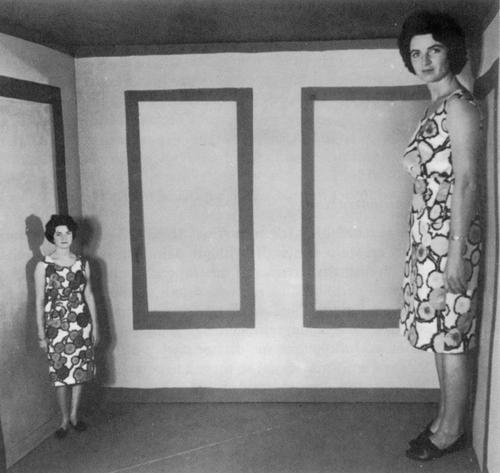
There are many variations of this optical illusion. Here is another that works in a similar way.
-
Yes, pretty much. Another way of saying it is that you reach a point and your brain goes, "hang on it makes more sense like this".
Almost certainly with distant objects, as they are also quite stable mathematically. But a very interesting question, certainly there is a point when viewing photos away from the centre of perspective where you are seeing more of the true perspective in that image so that does suggest it the very least not constant. I do not know for sure but would guess that there is some sort of hierarchy with the way we combine our binocular vision. As with a lot of these illusions, i.e. cafe wall illusion and the muller-lyer illusion, though the effect may be empirical the trigger points can be a precise function of pure geometry because that is the image projected on the back of the retina. So the concepts are still firmly rooted in maths, and even a basic working hypothesis is far more useful and easier to understand if you stick to the maths.
Pure geometry describes everything up to and including the back of the retina, then there's a layer of processing that's empirical in nature it prevents you from relating what you see directly to pure geometry without taking into account the nature of human vision. It is there precisely to provide you with a consistent understanding so you can believe that your vision is absolute and so act on it with complete confidence.
-
I'm just going to name them, if anybody wishes to google. The picture is The Ames Room, and the link (I think) is similar to the Ponzo illusion.
-
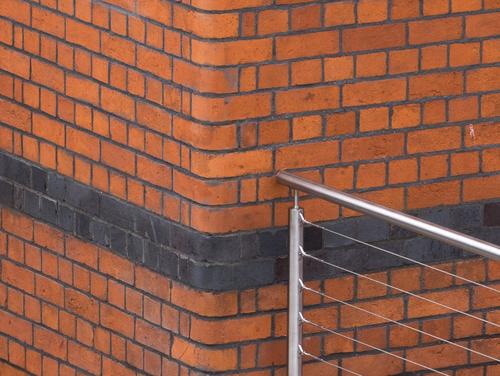
An image that I find relatively easy to see in both telephoto compression and normal perspective is this one:
The centre of perspective for this image is at a distance of just over 13 times the length of the diagonal.I have put an approximately 10" x 8" print of this image on a convenient wall in my home so that I can view it from normal distance (34cm) or from further away up to the centre of perspective (450cm). At normal distance the corner of the building appears to be much greater than 90 degrees, but from 4m away, or thereabouts, it looks like the corner of a normal building (i.e. 90 degrees). I don't know if others will see the same, but even having looked at this picture many, many times, it is still very obvious to me that the corner looks to be 90 degrees when viewed from the centre of perspective (or anywhere around there), but it looks like a much more obtuse angle when viewed from less than a metre away.
Does anyone else see this too?
-
[deleted]