• Members 1669 posts
    Jan. 13, 2026, 6:02 p.m.

    Kodak DCS 100

    A Foundational Milestone in Digital Photography
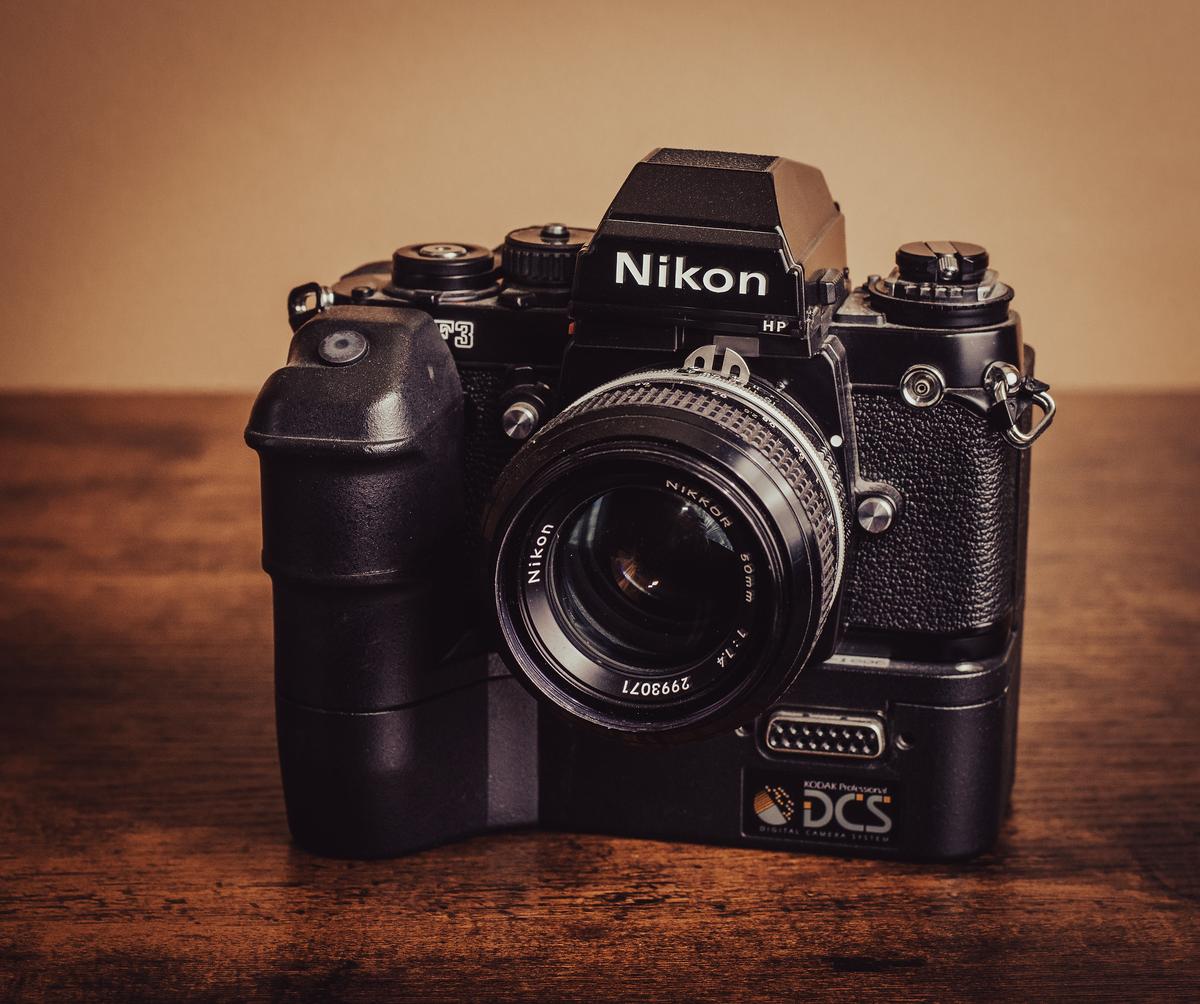
    Kodak DCS 100 Pro Digital Camera (1991).jpg

    Kodak DCS 100 (1991) / Nikon D500 ( 2016)
    www.flickr.com/photos/maoby/albums/72157672960370835

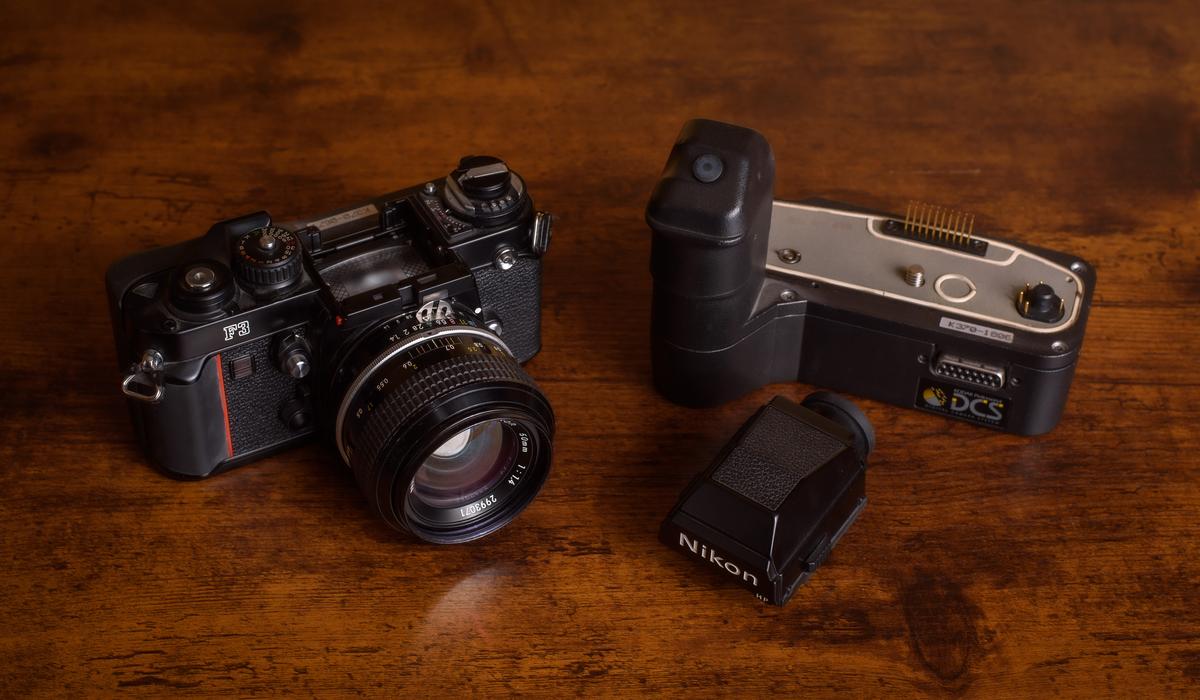
    The Kodak DCS 100 occupies a central place in the history of photography and is widely regarded as the first commercially available digital single-lens reflex (DSLR) camera. First presented at Photokina in 1990, it was released to the market in May 1991, marking a major technological turning point in professional imaging.
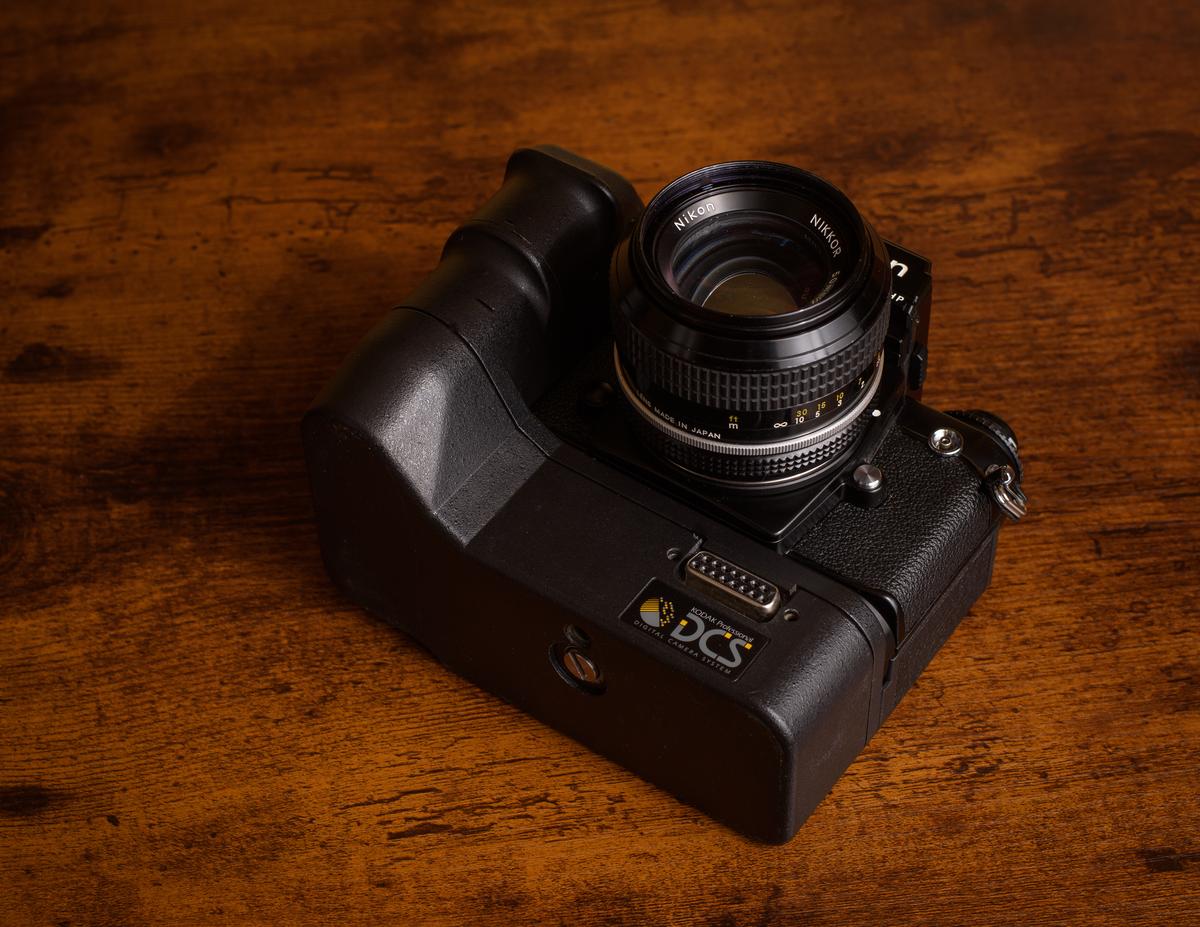
    Developed by Kodak using a Nikon F3 camera body, the DCS 100 incorporated a 1.3-megapixel color CCD sensor—a modest resolution by today’s standards, but revolutionary at the time. Unlike the experimental digital still cameras of the late 1980s, the DCS 100 was clearly conceived as a professional tool, both in its ergonomics and in its integration into established photographic workflows.
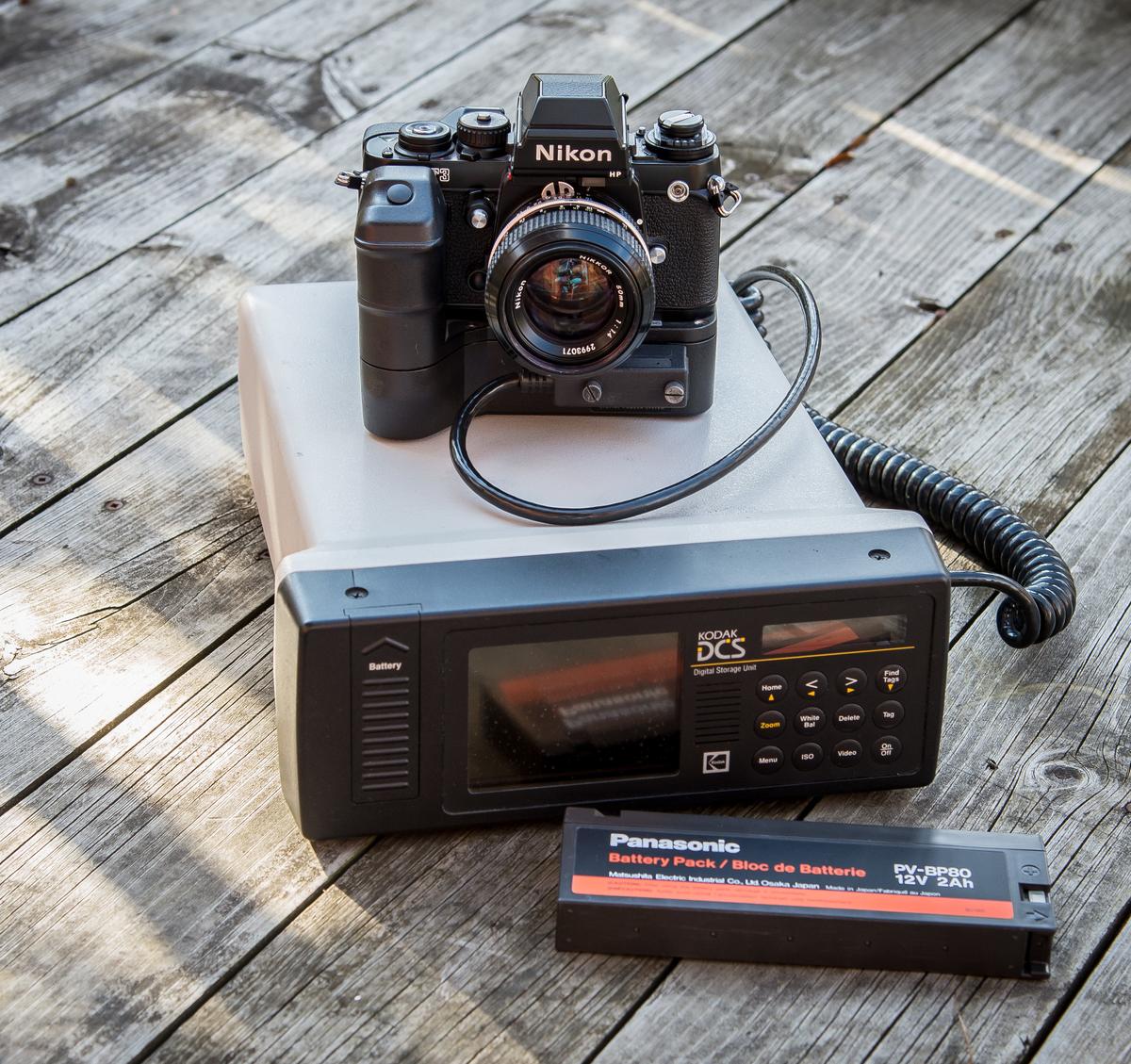
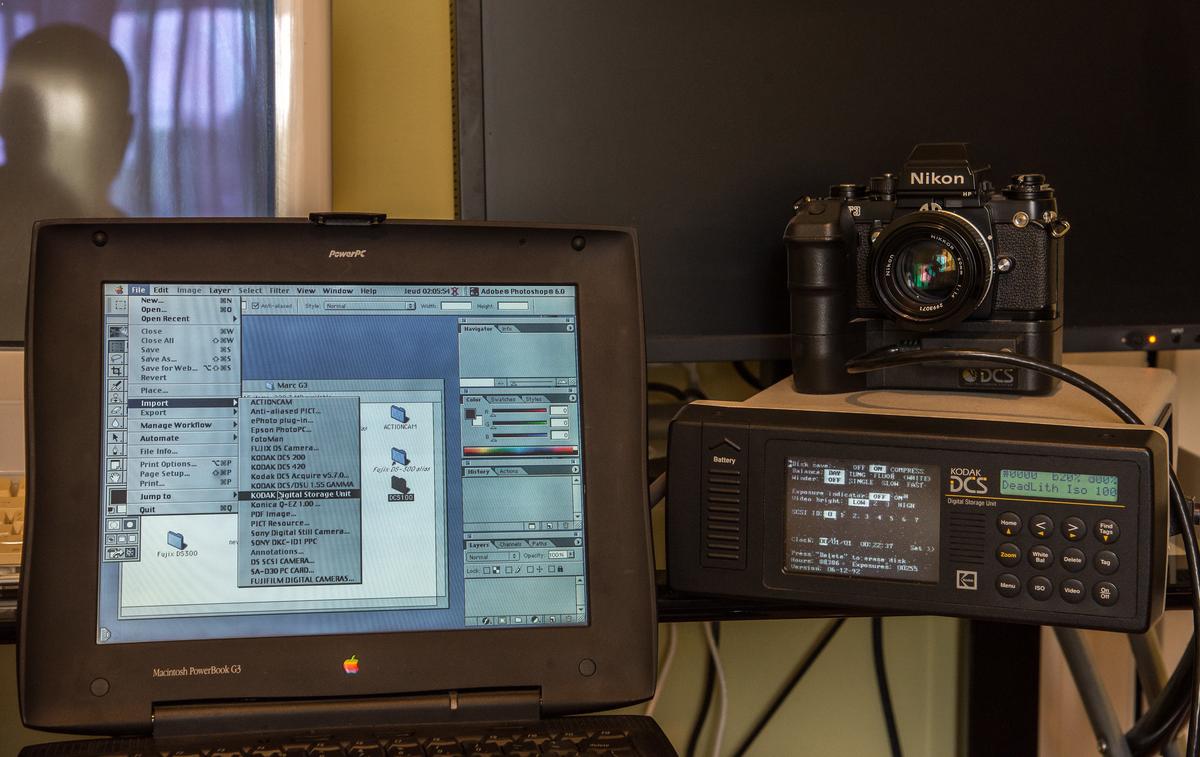
    The system was distinguished by an unconventional architecture: image capture occurred in the camera body, while image storage and initial processing were handled by an external Digital Storage Unit (DSU), connected by cable and equipped with a 200 MB hard disk. This configuration allowed the storage of several hundred images, a decisive advantage for press photographers compared to the limitations of film.
    Intended primarily for news agencies and photojournalists, the Kodak DCS 100 enabled much faster image delivery and significantly reduced publication lead times. Its price—approximately US $20,000 at launch—restricted its adoption to institutional and professional users. Between 1991 and 1994, an estimated 1,000 units were produced and sold.

    Although quickly surpassed in technical terms, the Kodak DCS 100 laid the foundations of the modern DSLR. It demonstrated the practical viability of digital sensors in professional reflex cameras and initiated an irreversible transition toward fully digital photography—one whose consequences continue to shape photographic practice today.

    Kodak DCS 100 .jpg

    Obsession
    www.flickr.com/photos/maoby/albums/72157632746948711/

    Kodak DCS 100 .jpg

    JPG, 200.0 KB, uploaded by Maoby on Jan. 13, 2026.

    Kodak DCS 100 Pro Digital Camera (1991).jpg

    JPG, 910.8 KB, uploaded by Maoby on Jan. 13, 2026.

  • Members 664 posts
    Jan. 13, 2026, 8:05 p.m.

    Hi,

    Seems like it was a lot longer ago than 35 years....

    Well, as the frog said: Time's fun when you're having flies! ;)

    Stan

    Amateur Photographer
    Professional Electronics Development Engineer

  • Members 1669 posts
    Jan. 13, 2026, 11:46 p.m.

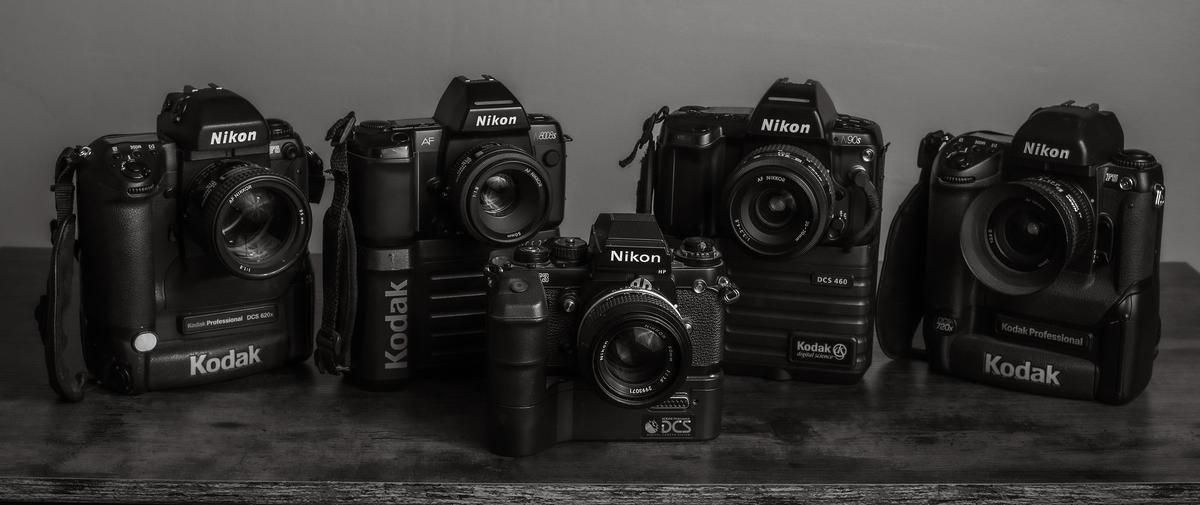
    Don't forget that the Nikon F3, which serves as the basis for the DCS 100, dates from 1980 (46 years old).

    Kodak DCS 100 Pro and these descendants.jpg

    Kodak DCS 100 Pro and these descendants.jpg

    JPG, 309.3 KB, uploaded by Maoby on Jan. 13, 2026.

  • Members 1743 posts
    Jan. 14, 2026, 12:53 a.m.

    I am quite in awe of what has been achieved over the years in miniaturisation of technology and manufacturing of same. Plus digital electronics.

    It is quite funny how on some forums various people whinge and argue about aspects of their cameras, with absolutely no comprehension of what lies under the bonnet...

    We are just so fortunate that these tools have been made available to us...

  • Members 1669 posts
    Jan. 14, 2026, 4:44 p.m.

    I can only agree with you on this. 😉

  • Members 664 posts
    Jan. 15, 2026, 3:11 a.m.

    Hi,

    Let us move the guts from a modern mirrorless to a fanny pack. See how that flies. :P

    But that is how it was done early on. Not just the Kodak models that predated the DCS, but the video cameras prior to camcorders as well.

    Stan

    Amateur Photographer
    Professional Electronics Development Engineer

  • Members 664 posts
    Jan. 15, 2026, 11:55 a.m.

    Hi,

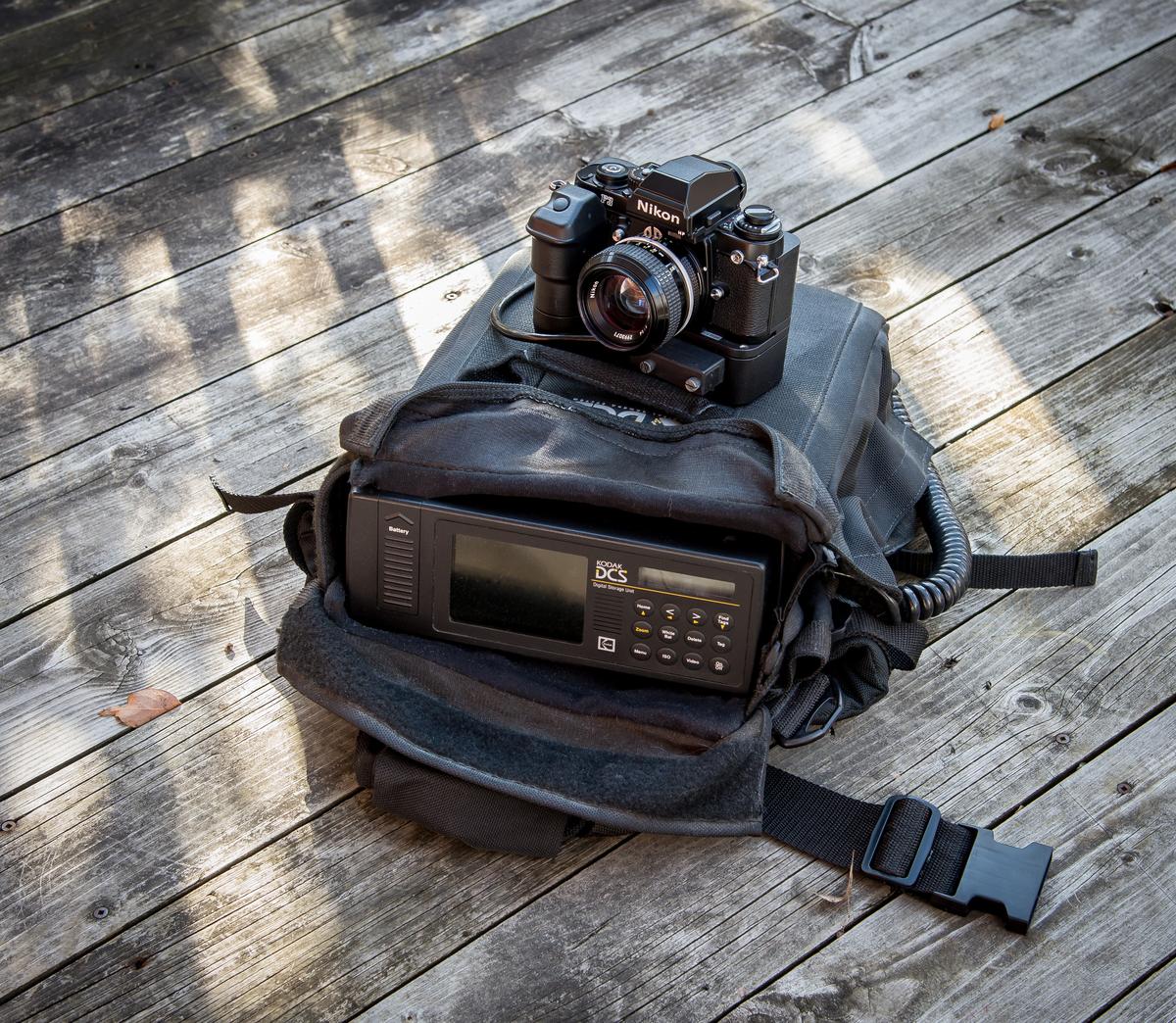
    I just realized...the pics show only the camera half of the DCS 100. The Data Storage Unit isn't shown. That slung over the shoulder and had an umbilical cable to the camera.

    So my comment about part of a modern camera in a fanny pack won't make any sense.

    Stan

    Amateur Photographer
    Professional Electronics Development Engineer

  • Members 1669 posts
    Jan. 15, 2026, 7:11 p.m.

    It's true that I didn't understand anything in your message.
    « Let us move the guts from a modern mirrorless to a fanny pack. See how that flies. :P »

    I was about to ask for clarification when I saw your last message.

    Here are some photos for clarification. 😉

    Kodak DCS 100  (1991).jpg

    Kodak DCS 100 Pro Digital Camera (1991).jpg

    49388694051_8407f77434_3k.jpg

    14350395138_70d181e567_k.jpg

    47954920711_f12bb02f06_3k.jpg

    51369963071_dee3ffe72c_3k.jpg

    51369963071_dee3ffe72c_3k.jpg

    JPG, 1.3 MB, uploaded by Maoby on Jan. 15, 2026.

    47954920711_f12bb02f06_3k.jpg

    JPG, 2.9 MB, uploaded by Maoby on Jan. 15, 2026.

    14350395138_70d181e567_k.jpg

    JPG, 2.8 MB, uploaded by Maoby on Jan. 15, 2026.

    49388694051_8407f77434_3k.jpg

    JPG, 2.0 MB, uploaded by Maoby on Jan. 15, 2026.

    Kodak DCS 100 Pro Digital Camera (1991).jpg

    JPG, 5.3 MB, uploaded by Maoby on Jan. 15, 2026.

    Kodak DCS 100 (1991).jpg

    JPG, 177.4 KB, uploaded by Maoby on Jan. 15, 2026.

  • Members 687 posts
    Jan. 18, 2026, 6:10 p.m.

    @Maoby don't remember ever seeing the giant storage unit. I've always seen the later very tall camera. They are huge. This one is crazy. Interesting there is a Panasonic battery. Did they build part of this system?
    As always fun and educational.
    Thanks for sharing,
    barondla

  • Members 1669 posts
    Jan. 18, 2026, 9:01 p.m.

    I couldn't say whether Panasonic participated in the DCS.

    Panasonic Battery Pack PV-BP80.jpg

    Generally, PV-BP80 12V Battery Packs
    It was used as a power source for some VHS/Panasonic camcorders and other older portable video devices.

    And to complicate matters further, the charger is a CHINON brand! 🤔

    Panasonic Battery Pack PV-BP80 : CHINON  charger.jpg

    Panasonic Battery Pack PV-BP80 : CHINON charger.jpg

    JPG, 132.5 KB, uploaded by Maoby on Jan. 18, 2026.

    Panasonic Battery Pack PV-BP80.jpg

    JPG, 114.2 KB, uploaded by Maoby on Jan. 18, 2026.

  • Members 664 posts
    Jan. 18, 2026, 10:14 p.m.

    Hi,

    The DSU was an all-Kodak R&D shop project. Of course, many components were sourced elsewhere. Such as the batteries.

    The Big and Tall design was the result of shrinking what came before. We were all going hammer and tongs at that (back in my IBM days). Such as we at IBM coming up with Microdrives to provide a decent amount of storage for the time in a miniaturized package.

    Another note is that the DCS originally had no number. Later, with the advent of the shrunk down, but still big and tall, DCS 200 the original DCS gained the 100 model number.
    Stan

    Amateur Photographer
    Professional Electronics Development Engineer

  • Members 1669 posts
    Jan. 20, 2026, 3:08 p.m.

    I read somewhere that a journalist, when talking about the new Kodak DCS 200, had simply referred to the first Kodak DCS as the DCS 100.
    And the name was simply reused later on…

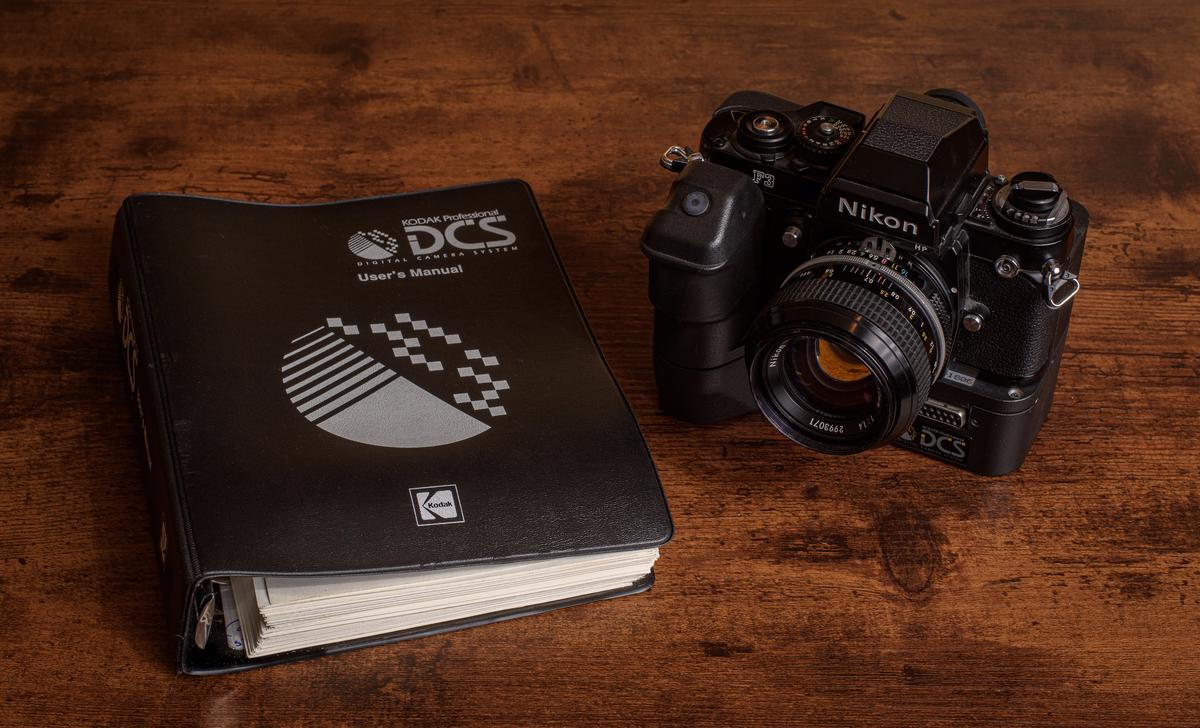
    Kodak Professional  Digital Camera System.jpg

    Because the name "Kodak DCS 100" is nowhere to be seen written on the camera or in the several hundred-page User's Manual.
    Its real name is "Kodak Professional (DCS) Digital Camera System"
    It's less sexy 😎

     Kodak Professional  DCS.jpg

    User's Manuel.jpg

    User's Manuel.jpg

    JPG, 6.5 MB, uploaded by Maoby on Jan. 20, 2026.

     Kodak Professional DCS.jpg

    JPG, 7.1 MB, uploaded by Maoby on Jan. 20, 2026.

    Kodak Professional Digital Camera System.jpg

    JPG, 4.5 MB, uploaded by Maoby on Jan. 20, 2026.

  • Members 664 posts
    Jan. 20, 2026, 3:18 p.m.

    Hi,

    Well, if Kodak had followed IBM nomenclature, they'd have used a four digit number followed by a dash and then 001 for the first model in a series. Or, perhaps a mix. DCS-001 for the first one, then DCS-002 for the next on. And so on.

    In the end, they flipped the Dash Numbers into 100, 200 and so on. They were just a bit tardy with that 100. ;)

    But we got there in the end.

    And then they followed International Harvester where they had size and data digits in their model numbers. So then Kodak later had megapixel information and image type incorporated into the model numbers. Like 420c and 460m and so on. And the DCS remained.

    Stan

    Amateur Photographer
    Professional Electronics Development Engineer

  • Members 1669 posts
    Jan. 21, 2026, 4:59 p.m.

    I find that camera companies always have difficulty with their nomenclatures.
    Nikon is a striking example, as they had the opportunity to be able to reset everything, With the arrival of their ML.
    And who decided to name their first camera Z7 and Z6. 😵‍💫 ...

  • Members 664 posts
    Jan. 21, 2026, 11:55 p.m.

    Hi,

    I figured that was due to the R&D department which did those was the one that did the earlier, smaller ML cameras and used 1 thru 4 already. And they had a 5, a 6 and a 7 in mind but wanted to release them in reverse order. So the only real change was adding the letter Z which is really a sideways letter N. ;)

    Stan

    Amateur Photographer
    Professional Electronics Development Engineer

  • Members 1669 posts
    Jan. 22, 2026, 4:32 a.m.

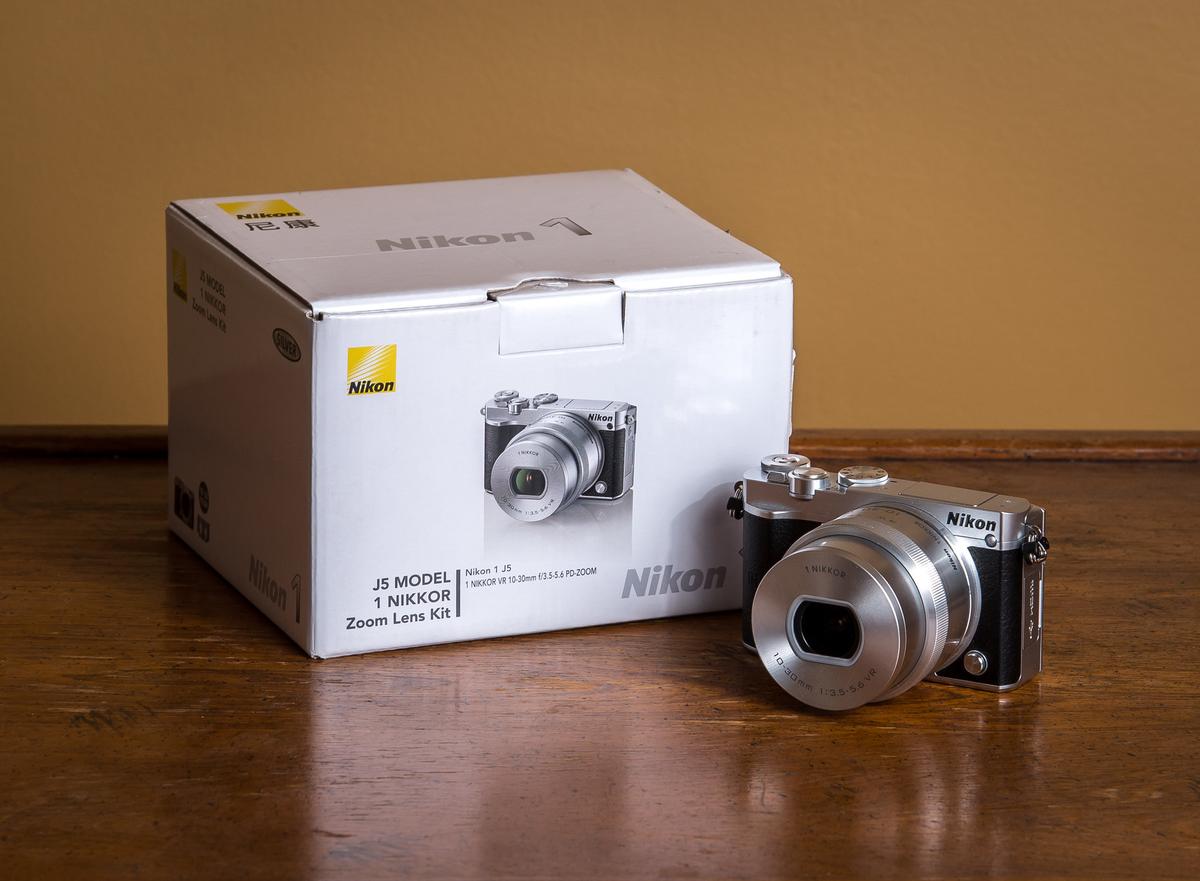
    A plausible explanation, except that the last Nikon 1 was the J5

    Nikon 1 J5.jpg

    Nikon 1 J5.jpg

    JPG, 407.0 KB, uploaded by Maoby on Jan. 22, 2026.

  • Members 664 posts
    Jan. 22, 2026, 12:22 p.m.

    Hi,

    Ah, well. As I always say: A Beautiful Theory, sailing on the Sea of Reasonableness, has been torpedoed by an Ugly Fact.

    Oh, and that model number, the J5, sounds more like a Champion spark plug than a camera. :P

    Stan

  • Members 885 posts
    Feb. 3, 2026, 4:58 a.m.

    I've been surprised by the fact that IBM hasn't complained to Nikon about their Z system cameras. z17 is the latest and greatest, but there was a z9 at one time.

  • Members 664 posts
    Feb. 3, 2026, 6:06 p.m.

    Hi,

    Hmmm. Yeah. IBM could pitch a fit there. I suppose they don't wanna bother. It isn't like anyone would confuse a Nikon Z with an IBM one.

    I gave up on IBM making any sense when they pointed me towards the door back in 1994. Oh, it wasn't that I was anybody special. I was just sticking radios into notebook PCs at the time. I used Ericsson as the vendor. And their R&D shop was about a mile away. Handy.

    What didn't make sense is that they decided to farm my work out to the vendor. Who immediately hired me to perform that work. Two business days after I was done as an IBM employee, I was back in my lab at my workbench as a contract vendor. So no real change except that IBM was now paying four times what it cost them to have me do that work as an employee.

    Not much sense there for me to make out of it. But it must have made some sense to someone.

    Stan

    Amateur Photographer
    Professional Electronics Development Engineer