I did some research on that topic. It seems that both goldfish and some species of salmon can see in IR and UV and visible. However, the article stated those were the only two confirmed cases. I have a friend that is a veterinary ophthalmologist and it turns out that there is are huge differences in how animals "see." Snakes see IR by specialized heat sensors with the data merged with the eyes in the brain. Birds have specialized cones in their eyes to detect UV. Some like horses and canine only have two color vision. But he always says that although the biology might indicate an animal has limited color vision, they adapt over time and it is often not detectable. It is a fascination subject especially over a few beers.
March 13, 2026
25
-

-
Yes, it does sound fascinating.
I used to work in the research & development department of diagnostic ultrasound company. We sometimes discussed about how bats "see" with their echolocation system. It seems that similar parts of the brain are used, that other animals use for visual processing. So they probably somehow "see" a 3D view of the echos as a "picture". -
I spent a large part of my career doing R&D in imaging radar and how to use those returns to detect other phenomena. The first thing one notices about a radar image or an MRI image is they don't look anything like what we expect. It takes a lot of training for a human to be able to interpret such images because of interplay of the underlying physics of the interactions with matter and radiation at those particular wave lengths. For example one can through on camouflage over a running truck and not see it from an airborne camera, but since it is running it will show up like in an IR camera. Put foil over it and IR loses it, but UV doesn't.
-

Appreciate the feedback. I went back and looked at some of my other images from this outing, and definitely agree it's a bit over done on the saturation. The warmth came a bit from whatever film recipe I used (which I don't remember) Here's an updated version. Reduced the vibrancy, saturation, brightness, and cooled it down- all just a little.
-
Wow, That sounds very similar to the medical diagnostic ultrasound imaging we did. Those pictures are also difficult for the untrained eye to interpret, but, over the years, the technology has become a lot better. The 3D images of an unborn baby's face are now truly amazing. And blood flowing through the chambers of the heart, coloured red and blue, by the doppler shift, make interpretation a lot easier.
-
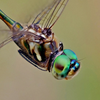
I was aware that most birds can see further into UV than us - they are mostly tetrachromatic. Dragonflies (and probably various other insects) have many more specific opsin genes that give them many more potential primary colours.
Watching birds and insects flying in the wind, I am convinced they can see the wind currents- which could be thermal or pressure based - or both.
-
Active imaging such as ultrasound, MRI, SAR (synthetic aperture radar), etc. contain information that is not often exported. I worked on a DARP contract teamed with Johns Hopkins School of Medicine and Essex Corp 20 years ago to apply optical signal processing (that had been applied to imaging radar ) to real time MRI. But what tends to happen is pretty much goes this way. Something strange is seen in an image. Then once one starts to investigate first the mathematics and how the artifact could have originated, one discovers it is probably real. Then one has to start to determine the physics that could have caused it. The one finds on top of the building there is an air-conditioning vent with louvers. The louvers are oscillating and the oscillations are being detected in both the range data and in the cross range data (Doppler). That led to a capability to determine there was activity in the building. Of course increasing computer processing horsepower is a big factor in unlocking the full capability of what active imaging can show.
-
Yes, imaging technology is fun. I worked in the ultrasound imaging field for 12 years, then moved on to the Semiconductor industry; where I've just retired after 30 years with the same company. I had some really good and interesting times there, in different departments, but, to be honest, it was the work done all those years ago as a physicist in medical ultrasound imaging R&D, that was for me most memorable and rewarding.
At least we have photography these days to keep us busy :-)