Fascinating study of conveyance in a country most of us will never see.
There is a magazine article in this series, about the role of mechanized wheels in culture.

Fascinating study of conveyance in a country most of us will never see.
There is a magazine article in this series, about the role of mechanized wheels in culture.
Atmosphere is everything here: a cold wintry scene with a lovely sky and an interesting building hiding behind the trees, everything dusted with snow.
A bit of shadow raising might let us make out more of the interesting building, and a bit of highlight lowering might generate more detail in the interesting sky.But an appealing image nonetheless.

Thanks. That's much better. The tone range of the B&W is clearer as is the wealth of detail in the pots.
The variety of size, shape and decoration is imprssive and isn't what we might have expected from a simple village. The bike transport and riders keep us aware of where we are. There are significant triangular shapes in the composition. First, positioning of the bikes and the suggested lines from the larger pots on each side. They are coming at us and the engagement is further made with eye contact from the closest riders. The hats add more triangles. There are solid blacks in the fore/midground while the backgound is in soft greys. The distinction adds depth to the shot but we still have sufficient detail behind to grasp the locality.
Can you remember what the long bamboo poles were for? They look as though they might be oil lights. Surely not?
A shot full of interest.
As in Roel's B&W shot, The purer blacks of the fore/midground fade to lighter greys in the backgound and so create visual movement and depth. The subject goat is beautifully positioned on the but the positioning ensures bullseye of of an X formed by landscape lines. Proportionally, he/she is small but the positioning ensures he/she is the subject. At the same time, the relative size underlines the scale and grandeur of the landscape.
A fine capture. After writing this, I think "capture" is not a good word. "record" would be better.
If I recall correctly, the long bamboo poles seemed to be for balance.
Because the transport bikes were so fully loaded, the user could hardly reach down towards the saddle for putting his/her second hand there (with the first obviously on the handlebar to steer). Being able to grab higher and with a wider spread between both hands, also made for a much more stable overall position. I don't know what the tin can was for, but certainly not a lamp. Maybe added weight for balance or just a means to identify one's bike?
This is a marvelously classic beauty of a landscape image.
It really has it all:
interesting structures in the mountains and rocks
enormous depth with so many layers of mountains taking off into the far distance
the Gams hiking up the steep slope of the rocky outcrop, at first a bit hidden in the black and white mosaic of the image, but revealing itself for a wonderful bonus.
But let me tell you what really got my imaginative juices flowing (and this is also the reason why I had to go looking for the Gams, because what I saw here was so dominant that it almost became hard to find other features...): it is those two trees, the one at the top and the other slightly behind, "catching up".
I get an overwhelming "father and son" vibe from those trees, and they almost feel dynamic.
The father leading the way and standing already on the panorama point.
The son following, a bit behind and a bit more out of breath, but catching up to his father.
I can see why you value this image.
And your title is very suggestive: you see the downturned flower as a protective umbrella over the light under its wings.
If you hadn't given us that title, my view of the image is different (but also nice and symbolic).
In fact, I still hold on to that other interpretation (that resulted from my first impression, before reading your narrative and title).
And my interpretation is that the flower is not protecting, but distributing light: the flower bows lightly to let sweet honey-coloured nectar flow.
My view is more about sharing than about protecting.
Those are very nice action images of wonderful creatures.
I don't think I have said this often, but this is a Minnie image that I am not really enamored with.
I think I can see what you were doing and the effect you were aiming for, with the layers and the dune grass acting almost like a veil in front of the main subject, but it does not work for me. My impression is one of confusion and distraction, and I also feel that the lighthouse being dead centered in the horizontal axis does not help.
I'm really sorry that I can not be more positive about this one.
This was a great travelogue photo essay that really gives the viewer a feel of what it means to travel in Laos.
Very good selection of shots and viewpoints, with an introduction that first shows us the state of the road, then a collection of motorcycles used as multi-person transport, and then finally the anecdote of the traffic jam. Really well composed and presented.
In fact, your series here catapulted me back to Vietnam (the same trip of the Bat Trang visit, and my only time so far in the country).
We also had quite a number of driving hours on our trip (although we did not attempt to visit the whole country: no Hoi An and no Ho Chi Minh, in fact nothing south of Hanoi).
On the first day or two I was content to sit and watch during those driving times.
But then the photographer erupted and I asked our driver for me to drive shotgun (and to please keep the windshield clean, which resulted in him getting out a cleaning rag at every stop), because I wanted to shoot some of what we saw on the road, without having to ask for stops (and in fact, most of the interesting stuff would have been gone if we had stopped, as most of it was dynamic and moving).
So "shotgun" became quite literally "shotgun", and it resulted in a gallery of images that I have called "windshield photography" (although some of it is of course also photographed through the side window, with a different shutter speed setting).
The delicate looking petals surround and seem to protect the globe of light. Even so, the globe has some freedom of its own. There is something of a mother with toddler at work here. A simple but highly evocative image.
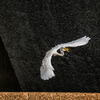
Quite spectacular. All that speed frozen at the precise moment the beak has penetrated the water and yet the eye in both is still above the surface. The wing spread and the individual feathers are sharply defined. In both, horizontal blue lines suggest peace and this complements the speed we know has been caught here and the zig zag lines of the subject's action.
A great "catch" in every sense of the word.
Hmm. I'll make a case for it.
This isn't minniev's usual territory in colour tones or subject matter. minniev usually suggests human warmth in some way or another.
minniev is self deprecating about the shot as well and refers to the plants as weeds. That's where I see it differently. Those are grasses on sand dunes. Grasses on beach sand, in my part of the world anyway, are highly valued on beaches for stabilizing the land. On many beaches we try to protect them with boardwalks.
All the narrow lines plus the colour link the grasses with the light and breakwater. In their own way, all are protecting.
Too long a bow?

The photo is fascinating.
If you need to transport large numbers of breakable items, with some of those items being big and heavy, then balancing them on a bicycle seems to be an unlikely choice. I suppose the benefit of being fairly affordable and readily available outweigh the disadvantages. You can also ride the transport home after delivery.
The choice of B&W makes it harder to date and gives it both an old feel and a timeless quality. The foreground is crisp and contrasty and the background greyer, which separates the main subjects from the background and gives them a presence.
It creates a sense of interest in the unknown and a desire to learn more or even see it for yourself.
When I first looked at this, I thought it was a shame that the Mountain Goat was not on the peak of the hill between the trees, where it would be most prominent, but I don’t think that now. If it had been, the emphasis would have been totally on the animal, but it would still have been small in the frame and rather insignificant. It would have been an unsuccessful wildlife photo. However, this is a landscape photo, and a good one at that. The mountain goat is not immediately noticeable, and only found whilst admiring the landscape, just as in real life, but once discovered, it is large enough to look at and appreciate.
I love the arch-shaped rock in the foreground, standing clear of the snow and tree covered ridges in the background.
I love the title and it certainly influenced the way I see this. The protective umbrella instead of being a sunshade to protect from the sunlight, it is protecting a rainbow ball of light itself. It is a lovely concept as well as making a fine image.
As photographers, one of our main tasks is to curate what the viewers will see. Decide what the subject will be, how it is presented and what will be left out. This censorship is very important.
I have often thought it would be fun to show the image and then a separate one to include whatever has been left out. I have never done it properly so well done for actually doing so.
The image of the pyramids is a lovely peaceful and atmospheric one too, one of the best I have seen of them.
You certainly caught the decisive moments with these two, as the beak just penetrates the surface of the water. Of the two I prefer the second, as the diving bird is more central and there is no distraction by the buidings or bridge on the horizon.