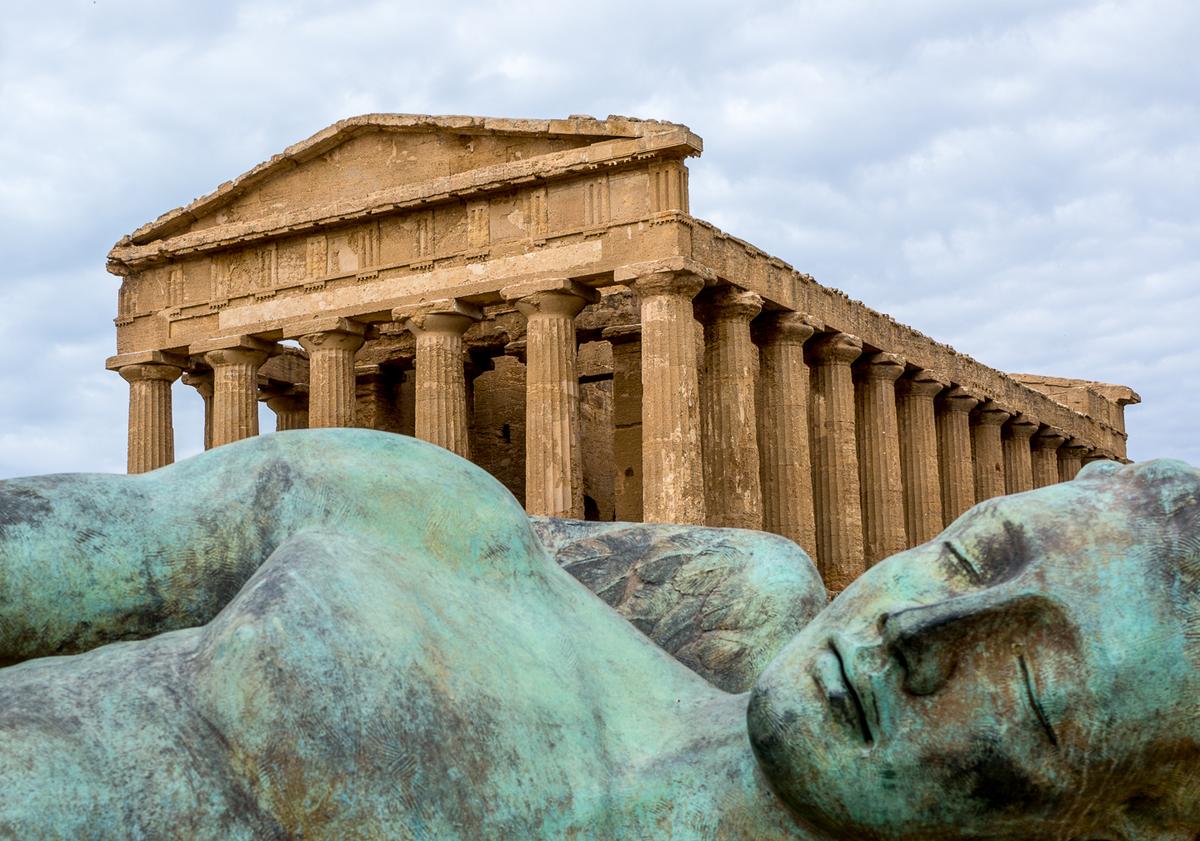
A very nice photo.
I agree with others, less roof would make this photo better.

April 8, 2026
59
-

-
A vibrant and beautiful photo.
I've never seen snails like that in nature. -
A well-executed photograph of the building.
The stairs draw the eye to the building and what lies behind it. -
Very interesting photos from a show.
-
Very expressive photo, I like it.
-

Adding a little to Roel's analysis of the series as seen by a magazine editor. Knowing that the person is a volunteer from the audience who has not done this previously or shared in the elephant's training, is very important here. Sagittarius opening "Would you like to be this guy etc... is critical to the impact of the shots. We are aware of it in every image. It makes the exploratory trunk of shot one much more meaningful an likewise for the raised and planted feet of the shots that follow. It's a great series and no, I wouldn't have volunteered.
Shots 2,3, 4 are all even better for the mirror like repetition of the elephant shapes. Shot 2 I suggest removing the half shown white figure leaving the frame, top left. But I'd definitely keep in the barely seen photographer, bottom right in all the shots. He helps identify the spectacle for what it is.
The yellow and red cloths on the elephants are excellent in giving visual punch here.
A terrific series. -
Agreed. Although I'd trim a little off the bottom and eliminate the paving and maybe tilt the image a fraction more to the left. Also a maybe, I'd experiment with the exposure. Possibly I'd increase the overall brightness and contrast a tad.
Art deco usually appeals to me although I had never thought of it in a Canadian setting. It's the combination of multiple horizontal and vertical lines in this image that makes the shot. -
Lots of questions. The classic coke bottle and top in a surprising treatment. Rhetorical questions. Is it an advertisement or a work of art? Is the grey stairways scene a reflection, a view through a glass surface or an image printed on the bottle shape> I don't know but I'm guessing that if you had taken the shot from square on, you might have appeared in the scene, which may be why you took it at an angle.
To emphasize the classic coke symbols, including the whole of the cap might have worked better. I can see from the dark line at the very top edge of the upper left grey area that there may be something like a window here that would then have shown and I can understand why you wouldn't want this in the final image. If so, Dr. Adobe to the resue to eliminate it but of course this depends on your philosophy of photo taking. -
I'm guessing. I don't think think the figure is a fallen angel but Icarus. There is a very, very similar statue in front of the temples at Agrigento. I spent a lot of time lining the Agrigento statue up against the columns from different angles. If so, it's a modern statue of the fallen Icarus by a Polish sculptor.
Visually, the photo links the statue and poster through the bird wings and I presume that was the intention of the display. The symbolism of a fallen Icarus, or angel, sits oddly with the bird as a peace symbol however.
A footnote. It's a few years since I was in Pisa and the statue wasn't there at the time so I presume it really is a modern addition. -
Thanks for the comments, Mike. I agree with most of what you said. 1 & 2 were just "there'" so I snapped them. I don't know why I included them here really, except they seemed amusing to me.
-

I enjoyed the series with many unusual scenes of Niagara, but these four were my favourites.
A) shows the falls from an unusual angle, with the telephoto compressing the image into an almost abstract series of shapes. But one of those shapes in particular, the bird, pulls it back from abstraction, and makes it an intriguing photo of an extreme natural environment.
B) The rainbow is cool in itself, but it is another detail, which amuses me. Sometimes the souvenir photos in front of a must see sight can become oppressive, especially if more than one member of the party insists on capturing their own version of the scene. “Stand there!” “A bit to the left!” “Smile…”. Here the photographer seems to be leaning towards the model with gusto and she leans away, pushed by the onslaught. It’s an optical illusion, but I like it.
C) there is a famous photograph of a cinema audience all wearing 3D glasses(by J.R. Eyerman, thanks to Google). They look rather absurd, all wearing the same rather unusual gear, and this photo has the same vibe.
D) again it is the fact the whole group are wearing unusual clothes (Amish?) with no other tourists in sight which generates the interest here. It is enhanced with the modern world of steel and glass as a background to an ultra-traditional group.
-
As others have already said, it is the contraceptive vending machine in the background which lifts this photo to a whole new level. The driver doesn’t stop to buy, as it seems he has done on at least three occasions before (although, what is that hanging from his handlebars?)
I also like the girl’s eye-contact. -
I think the composition works well. The roofs at the top actually go well with the structure on the right, although I would crop some of the roofs off, but without cutting off the top of the tree.
-
Entwined in a loving embrace. Not a phrase I would normally associate with snails! The curves of their embrace, their shells, the textures on the shells and on the snails themselves are a contrast to the criss-crossing lines of the grasses and you have used those ingredients to make a very pleasing composition.
-
Very elegant! I like the visual journey up the stairs to the ornate doorway and even beyond. The person climbing the stairs is an important emphasis of this effect.
I find the shiny floor at the bottom of the photo to be distracting and would crop most of it off. -
I find the first two to be a bit messy, with lines camouflaging the subject, but agree with you and others about the flowers and church. The yellow daffodils stand out nicely against the bluish background.
I also enjoy both motion blurred photos.
Not so sure about the last. I appreciate it for reasons Mike has pointed out, but then a moment later I find the composition to be too straight up and down. -
This is a delightfully surrealistic photo! The main subject is a bottle, but it is not a bottle but a stairway, or not a stairway but a reflection of one, or is it a window….
Nice one.
-
I think it really is a fallen angel, because that was the title of the sculpture. However, you were spot on with the Polish sculptor! After some research, I discovered that the sculptor, Igor Mitoraj, created a series of Icarus sculptures in the 1990s, which were exhibited at Agrigento, but this Fallen Angel was created later, and was not part of that series.
The peace poster and sculpture was not a display as such. These posters were hung in many places and not just here, but I noticed that they played well together. I wanted the viewer to make up their own mind on how the sculpture and poster were linked, for instance it could be the Angel of War under a victorious Peace, or simply visually contrasting shapes, but actually I saw it the same way Roel and Minnie saw it. The angel as an Angel of Peace or our Guardian Angel next to a rather ironic proclamation of peace. The orange/pink light in the poster was no doubt meant to indicate an optimistic symbolic dawn, but could also be from the flames of war, roasting the Dove of Peace. In fact I tried to encourage that thought by using a series of selective brush filters In Lightroom and drawing random wavy lines over the poster, brightening some and darkening others leaving a poster which no longer appeared smooth, but had wrinkles resembling flames. I did it in a hurry on the iPad version of LR, so it is a bit crude.
I also liked the negative associations with the barred windows and chains, which Minnie noticed.
Originally I was going to try to clone out the many visitors wandering by, but with a little patience and a lot of luck, I managed to take a version with no people intruding. -
Here's my photo of the Icarus statue at Agrigento. Taken in 2014. I can't remember but I think I posted it to Wednesday C&C years ago.
The concept and the decision to put it at a classical site is soi close to what has been done at Pisa that I reckon Igor Mitoraj could take legal action.
-
Roel prompted me to re read Pete's post. It's the same sculptor. In which case, he needs to spread his wings a little more instead of repeating the same concept.
-
Thank you for these thoughtful comments.
I was indeed looking for the not so obvious angles and combinations of the actual falls with interesting sideshows.
Without even showing the falls in the actual shot (as in the photo with the Amish group), showing these quirky things in the context of a series about the falls adds extra colour and shows how these falls are a natural attraction that appeal to so many different people. -
Pete,
I like how you selected your favourite 4 of the 10 and then provided detailed comments about why these were your favourites.
This is really helpful in getting a sense of the appeal of different kinds of images.
(Yes, I also assumed these people were Amish. The was not too long after the Peter Weir movie "Witness" with Harrison Ford, that brought the Amish to the forefront of cultural consciousness. Without that movie, I would have thought these were period reenactors of some kind. What I particularly liked upon encountering these people in reality, was the elegance of their Sunday dress and the matching colours.) -
The same sculptor has apparently been very active on various historic and archeological sites in Italy (and maybe beyond).
Your comment, Mike, seems to suggest that one of the sculptures was made and placed by a copycat, but from Pete's explanation, I learned that his research told him that it was indeed the same Polish sculptor, and images of Icarus and an Angel respectively. It makes sense to display Icarus on a Roman site and an Angel near a Catholic landmark.
You both made me go back to some images that I made in 2018 in Pompeii, where several modern sculptures were also placed.
One was a sculpture of a Centaur, and at first glance it could have been a Roman original, but at second glance there were details that revealed its modern character. Another was a classic standing bronze male, but with a little window in his back showing a small second face (maybe an interpretation of Janus?) and that detail, again, made clear that it was not original but a modern intervention on the archeological site.
At the time I did not note nor investigate the author of these modern sculptures, but running my images of them through Google Lens, it becomes clear that once again our Polish friend had been allowed/commissioned to do his thing there.
So here are MY echoes:


I have several more images of each sculpture in this gallery : roelh.zenfolio.com/p456943747
Some of those others show "better angles" of the statues (more context and/or less overlap with distant columns and pillars etc), but these two show off the "picture in a frame" additions best.
Makes me wonder if also your Angel and Icarus had the same feature. -
It made me wonder too. There is definitely no “picture in a frame” on the front of the sculpture, the side I photographed, but I never walked behind it, so could not be sure. Thanks to Sherlock Google, I can now confirm there is a “picture in a frame” on the Fallen Angel.