Another vote for 2. The clouds feel top heavy in 1. They don't seem to be part of the same composition as the flowers and both seem to compete for dominance so my eyes go backwards and forwards between them.
In 2, the cloud line, the trees and the flowers take the eye smoothly to much the same area and it all feels harmonious.

May 27, 2026
39
-

-
Knowing that hat this photo was taken ten years ago builds on the image.
Time passes. The people of The Korean War are fading into memories. A younger generation visits and brings the next generation with them. Already, their edges are blurring. The writing for all generations, so to speak, is on the wall.
A powerful photograph. -
Agreed.
A candidate with a twist for the Lonely Bench genre. Here, the sadness is generated by the removal of the bench. -
-
More on Last Week.
As Roel says, last week was special. Alan, have you been watching this discussion?
I don't know of any other photography site where it would take place. I treasure y'all.After more thought and back to my photo from last week. In recent months we have all seen horrific images from Gaza. I'd vehemently support the taking and exhibiting of these. We need to know.
My shot was different. I didn't take it to make a particular point. I wasn't communicating with the subject. It "works" as an image with the connection to the expensive bag. But I still feel it was exploitative and I avoid such shots now, unless I see a purpose for them.
While in Calcutta on that trip, I took a series of photos that unfortunately have disappeared. These were pretty raw but I felt OK about them. I met an "untouchable" on the street and he spoke English. As we talked, he showed me around the street and explained how his people lived. It was fascinating, complex and highly co-operative and organized. I was introduced to the people. I asked if I could take photos and we were all comfortable. No probs. I'm not meaning to preach about what is right and wrong in these matters. Our personal comfort boundaries differ for all of us and that's cool.
To lighten the mood, here's a street shot taken a couple of years ago where I didn't ask permission and I don't believe the subject knew it had been taken. -
The photo does the very striking colour combination justice. I very much like the framing. Unusually, the subject points are across the top of the frame while the long stems and the upward facing leaves create visual movement to the top.
I agree with minniev about the little red whatever it is top right. It attracts attention but is too indistinct to have a function here apart from distracting from the blooms. -
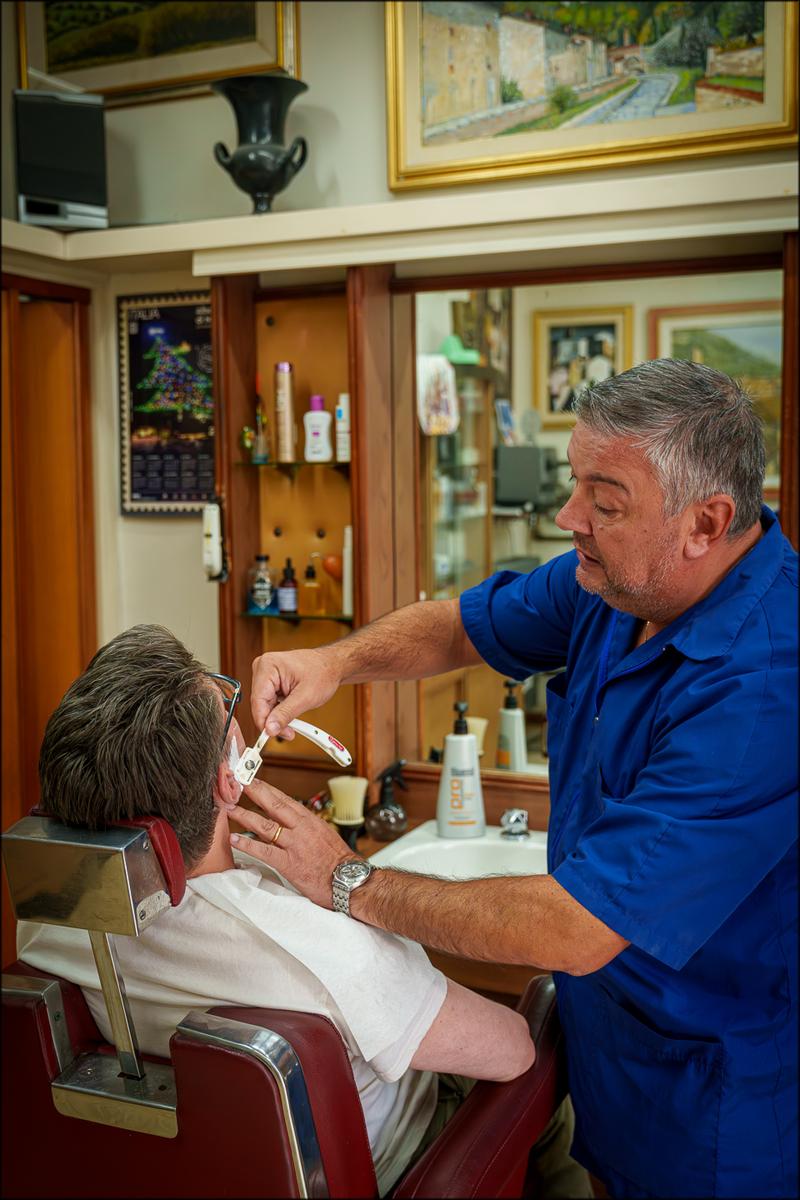
The subject enjoyed the shave and did not and does not mind the photo being taken.
-

Mike has added to our Street Photography discussion, so I will add to that whilst making comments on Roel‘s photo.
The brightest part of the photo and the clearest face are naturally what catches my attention. Then the older woman becomes apparent and she is doing something with the bags, but we can‘t really see exactly what she might be doing.
This brings me to another important part of deciding what is ok in street photography and what is not. The viewer.
The viewercould see the photo as an older woman being reminded of her youth by looking at the face on the bag. That is a perfectly valid observation and I would have no issue with it.
The viewer could see it as a poor older woman being confronted by a rich young woman. Then they would be making an assumption that the older woman is poor. There are hints, like her dirty finger nails and the fact she seems to be collecting old retail bags, but it is still an assumption. Similarly there is no real reason to believe the pictured young woman is rich, and it would probably be down to the advertising agency’s skill at suggesting an opulent lifestyle with their product. In any case it would be another assumption, which would reveal something about the way the viewer sees the world, or let themselves be led by convention and sales techniques. How they interpret the image and whether that matches their view of the world, influences the viewer’s acceptance or rejection of the photo.
The viewer could see it as a face from the establishment in the hands of a low paid worker. That would draw attention to the difference between the two, and then it would be important what the viewer saw as the photo’s message. If they see the older bag lady representing a worthless trade, and the model representing a respectable world, then they might get upset by the photographer’s intentions, but actually they have revealed themselves as seeing the world that way as well. They could also interpret it as wishing to show the difference as a comment on the social injustice between the two worlds, in which case they might praise the photographer. They may also see it, as Kumasi mentioned, as simply a documentation of the woman’s work and accept it as just as valuable as the model’s job, so again no offence would be taken.
The viewer could see it as a comparison between beautiful and ugly. This would be the most difficult interpretation and imply the viewer only sees beauty in youth and well-balanced features, or maybe even just in wealth. The viewer may praise the photographer for backing up their own point of view or heavily criticise for being so shallow. In any case if the photographer was suspected of seeing the world that way, it would drastically polarise the viewers.
Of course there will be other interpretations, but I hope that is enough to explain the point that I am trying to make
There are two very important viewers. Firstly the photographer, and how they interpret the scene when taking the photo makes a big difference as to whether the street photo is morally sound or not. The second is the subject and what she believes the intention of the photographer is. If she believes it is the ugly/beauty comparison, she may be upset or angry. If she thinks it is the age/youth comparison, she may just smile ruefully and actually agree, or she may still be upset that the photographer is reminding everybody of her lost youth.
After that it is all of us third party viewers, who make an opinion on the acceptability of the interpretation based on the criteria mentioned above or on their own criteria.Sometimes it is very obvious how the photographer interprets the scene, which may defuse some harsh critics if the trickier interpretations are clearly not intended, but it is often the ambivalence of a photo and the different interpretations it allows, which make a photo particularly powerful.
-
Yes, I feel the same way.
-
I really like this one. The reflections give a dreamy feel, which is enhanced by the grain, and the soldiers’ portraits seem to dance through the scene like ghosts, especially as they are B&W against the colours of a live world.
-
Unusually for a photo of a craftsman at work, he and the object he is making are moved to the edge of the composition and become secondary, scene-setting accessories. The centre of attraction is the neat array of tools and carpenters’ “Stuff” at the centre of the frame, and the interest it generates exploring their patterns and discovering the individual items.
-
Actually, I'm not sure what is happening here. When you look at the image large and explore the tools, they don't look as though they have been used for many years. Perhaps the man is using an old shop for the atmosphere, but not using the tools???
-
This is an interesting comparison.
The main difference is of course in the sky: fluffy small clouds in a bright blue sky in the second versus a more overcast but still interestingly shaped sky in the first.
I would (like you) have a hard time picking a favourite and am curious as to other members' opinions.The sky, however, is not the only point of difference.
While the herbs and flowers are similar in both shots, there is a difference in the degree of lower green showing through the top layer of white.
The first image is in that sense more "dynamic": it feels like those clouds above, also come with a fair bit of wind at ground level, that makes the herbs move and exposes the green of the stems. I like that effect, although I ALSO like the more uniform flower cover of the second. Again: a toss up. -
This is such a riveting visual puzzle.
Are we looking at reflections or through glass?
Are the colourful visitors and the monochrome monumental soldiers in the same plane or are some of them reflected and others not?I am inclined to guess that it is all a reflection, with characters of different generations: the soldiers from the past and those in the present who enjoy the freedoms that those soldiers helped preserve (at least: if we follow the patriotic interpretation of any such monument and not see the US's involvement in Korea, Vietnam, etc as neo-colonialism under the guise of "fighting the red menace")
Having visited DC many years ago, once (two days, in the summer of the year of Obama's first election as president), I remember vividly that the Korean War monument made quite an impression.
The solemn black marble or granite with names of the fallen in the Vietnam War (at least those on the US side...) was also impressive and gave pause, but there was something very visceral about those soldiers with their rain ponchos, walking in patrol formation through a simulated field. Very realistic.Your image literally reflects that realism, but provides us with an abstraction (another layer).
-
There is often an irony to be found in the confrontation between idealized people in sculptures, with their real-world human counterparts going about their daily business. This is a prime example.
-
Craftsman, but even more importantly: the tools of his trade.
I like what you were going for here, but I think that if room and space permitted it, I would have taken a slightly different angle (standing a bit more to the right and aiming a bit more to the left, to place the craftsman in front of his wall of tools, but mostly, to exclude the outside world on the street. I understand that maybe you wanted to separate the man from the wall by placing him as much in front of the window as possible (using the window as a frame and the outside brightness as a canvas), but the car bugs me. Without that car, the image is timeless. -
That, and also the other way around, just as much if not more.
The statues elevate the worker.
The worker elevates the statues. -
Agree. And "take a seat" is a great title. (I had not paid attention to the title when first writing my own comment.)
-
That is quite the roundup of possible interpretations of the image.
Thank you.
I've hinted at my own with my title, which can be seen as describing the condition of either of the two characters.
(I had of course the benefit of seeing the old lady in action for more than the split second of the image. -

The Korean War monument is my favorite to photograph. It's a two part monument, the amazing statuary of the patrolling soldiers and the wall with the portraits of servicemen etched in an irregular formation. This is a photo of that wall; the statues and the visitors and the background are reflections though they all appear to be mingling together. The rain was a bonus, making the wall more reflective and blurring those things reflected at the same time.
-

An interesting image with a lot of stuff around in it letting the eye walking around. I enjoyed the unusual composition. Technically the image can benefit from more structure (or local contrast) at the wall behind the guy. Then also darken his hair a little to mitigate the flare. The very bright outside, well, it is what it is. In any case, a good image.
However, not as good as the image from Hydra here which is great. Somebody already mentioned the image is too bright at the right side. I agree about that and I'm happy the man with the donkey finally decided to pass by when you were there. A great image.
Then, finally, the image of the black boy (the second image) in Calcutta here is OK. I understand your feelings but when presented together with text explaining the situation I don't mind. It's an interesting image provoking some thoughts. It is also taken at the right moment with the boy looking up towards the man with the big briefcase.
Thank you for the images!
/Jonas B
-
Thanks for your thoughtful comments.
Re the craftsman photo and similar thoughts from Roel on the highlit area. It was a grab shot with a low light interior. I was aware of the problems caused by the bright exterior on the right but I couldn't change my position to get a better angle. A lot of PP had to be done to raise the interior and avoid a complete burn out on the right. Perhaps the best way to fix the right would be to dip into Adobe tricks and try to remove the entire area and replace it with a generated fill. Maybe, maybe not. It would sure be a test of Adobe's generative fill.