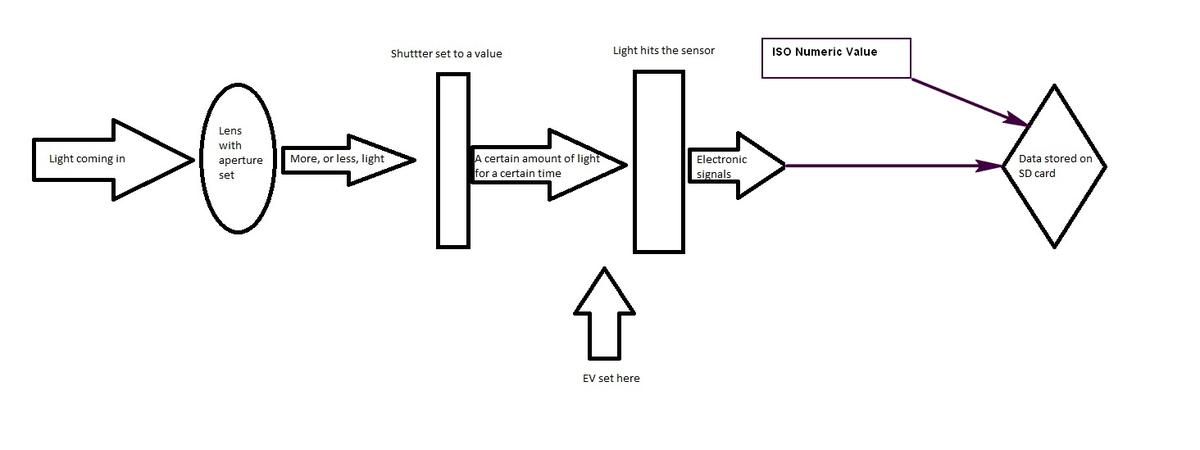
I think where you show exposure triangle actually amplification happens.
IMO exposure triangle happens when you set a camera to take a shot. You set three parameters (beside WB) - shutter speed, aperture and ISO values. You can see how changing any of three values is changing brightness of the image by looking at the live view or at the meter. ISO does not change exposure (amount of light hitting sensor) directly, but you have to change SS and/or aperture to achieve appropriate image brightness. Thus when shooting actions you need to use faster SS and in order to do that you have to increase ISO.

March 25, 2026
89
-

-
Nice diagram. Does not apply to all digital cameras, e.g. some Sigma/Foveon cameras have no "ISO adjuster", therefore no triangle.
-
OK, but the live view or the meter are taking the data from the sensor. Yes, you SET the parameters before you take a shot, but they take effect at different places in the light flow. Which is what I was trying to show in the diagram.
-
So you can't adjust the ISO on Foveon cameras? I didn't know that.
Alan
-
Of course you can, but in earlier cameras it was just a tag in image metadata and processing software used data accordingly. Camera internal preview used that too.
Starting from SD15 ISO value was used to change gain in "Analog Frontend", which is analog amplifier after the readout and before digitizing. -
Per edit below
Also DP1x, DP2x and all Quattro models.
-
you dont need to be able to adjust iso to form an exposure triangle eg : 1/30 sec, f2.8, base iso.
-
Trying to find a relationship between side values and inner points of the triangle where lines from the vertices to the sides cross over ...
Hmmm ... is the triangle "balanced" if the three lines from one set intersect in the same location as another set?
-
Why sides? There is one constant thing in triangle - total of all three angles (image brightness). Changing one angle forces change in one or two others.
-
Because the sides are scaled - keeping it vague 😉
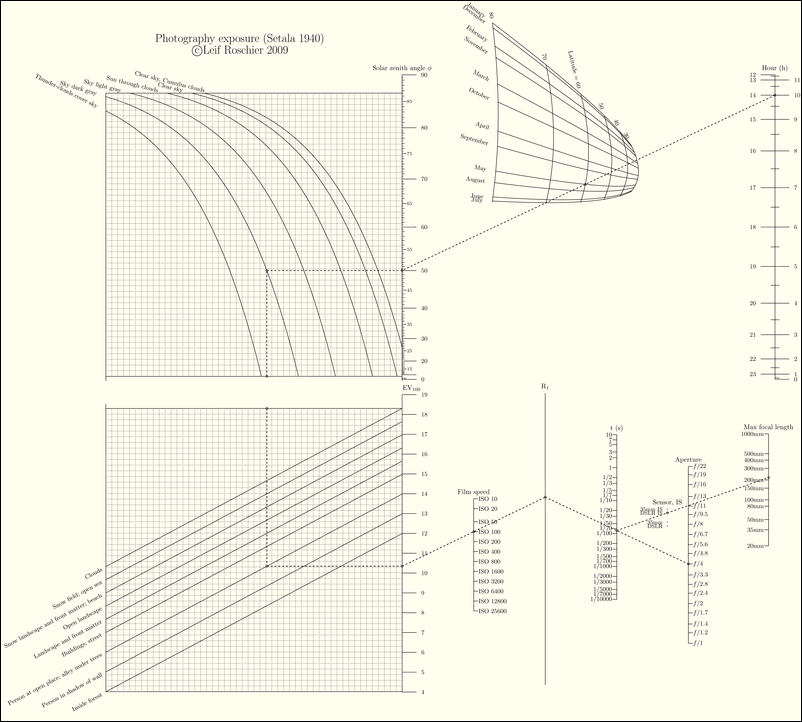
Explains why nomograms are more understandable to the technical mind rather than the vague...
My favorite from my birth year:
Just kidding - here's an easy one:

-
Dynamic range, DR
...is another “exposure related” aspect that should be considered when taking a shot.
As the ISO is increased the brighter objects in the scene will clip earlier.
This is because the extra brightness that you get from a higher ISO is made (partly/mainly) by just multiplying the digital values from the ADC,
Very soon the result of this multiplied output is higher than the biggest number that the RAW file can save and it will clip and cannot be recovered. (means less DR)So at High ISO, you will usually get more noise and less DR
-
Say three lines intersect in the middle ,,, approx f/7, 1/200 sec, 500 ISO = about 11 Ev. Say I move the f/# and shutter speed upward "to balance", while keeping the same ISO, say f/16 and 1/60 sec = about 11.6 Ev, so a similar exposure value but a totally different location within the triangle,so that ain't it ...
-
Make one angle ISO, second angle SS and third angle f stop. Now try to change (decrease) one angle let's say ISO. You will have to increase one other angle by the same amount or other two angles by half of that amount to keep total at 180°.
-
Sorry, not sure what is meant by "angle" in this context - the exposure triangle being equilateral therefore each included angle being 60 deg. Any chance of an illustration or two to help my tired 86-yr old brain?
-
This is to illustrate the relationship between these three parameters. By changing one angle (parameter) one has to change one other or two others to keep total which is always the same 180°
-
No illustration ... so unable to visualize your "parameters" ... I fold.
I've yet to find a triangle whose inside angles don't add up to180 deg, so obviously I don't get it.
-
Can you let your ChatGPT friend to visualise it?
Google search AI gives strong hint: The equation x+y+z=C represents a plane in three-dimensional (3D) space.
Visually it is tilted plane through three points (C,0,0), (0,C,0), (0,0,C), in positive octant (x, y, z ≥ 0) it looks like triangle. Exposure triangle, if you want :)Why this equation?
In short and wihtout constants, S * A * ISO = B, where S is 1/shutter speed, A is relative aperture (F/aperture), ISO is ISO value and B is resulting brightness.
Taking logrithm (as all components are actually exponential in nature), we getlog(S) + log(A) + log(ISO) = log(B)
Assuming we strive for constant brightness and substituting logarithms with x, y, z and C correspondingly, we get
x + y + z = C
You may draw it out now :)
-
I put your whole post to AI:
After bashing the Exposure Triangle for 20+ years, I've never seen such a clear mathematical explanation. Thanks for pointing me in that direction. The "Small Correction" explains why the common simple diagrams don't appear to tell the full tale.