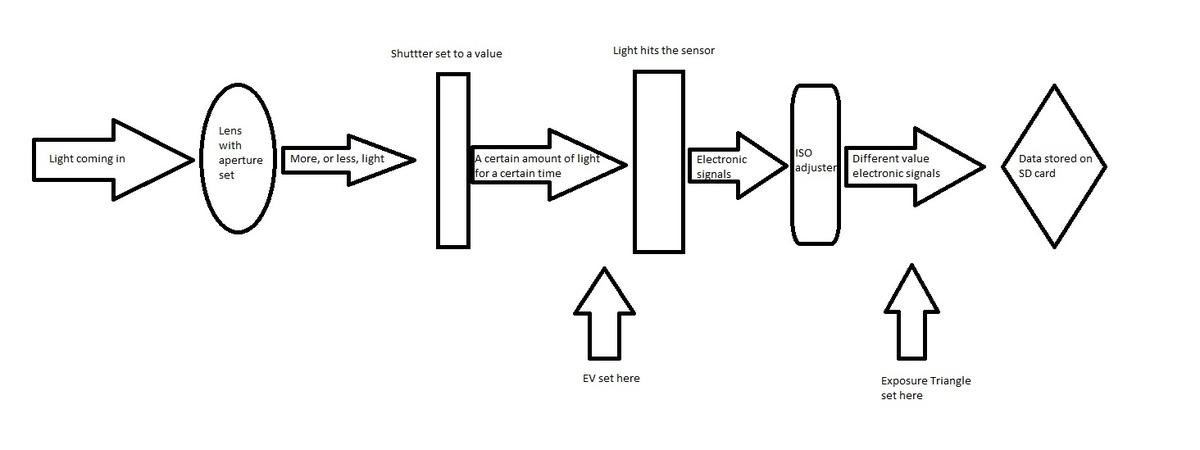
Well I got the chance here with this thread to show everyone my fantastic general exposure method ;-)

March 25, 2026
89
-
-
Sure, in practice it works. I work most of the time at base ISO and I the three parameters will give correctly exposed pictures, if I change speed or aperture.
-
Maybe it is time for an "Equivalence" thread too.
-
Maybe not. 😁
-
There's two different things being discussed here.
The exposure triangle is perfectly valid as long as you recognise it's what ends up on the SD card - so it's not "exposure" as such, but the end result uses 3 different things to produce the final output. It's a useful way of thinking about the parameters needed to produce a good image.
Then there's the 'sensor' argument. Mostly a load of rubbish as ISO is set after the sensor, not on it.
And that should be an end to the discussion (but I bet it isn't). 😂
-
I like circular slide-rules or things like this

😏
-

That is my thinking. A beginner mostly only thinks in terms of brightness or lightness. Let them learn the parameters involved in that process and further down the track when they are ready (if ever) they can learn about exposure.
As far as I know, high school science still teaches that electrons exist in shells around the nucleus. It is a valid introductory concept that is enough to then learn about valence, basic chemical bonding etc. Even though it's completely wrong...
We could rename it to "The Brightness Triangle" and "The Exposure Relationship"
-

The best tool available for this are actually Sony's "Zebras". I don't know why other manufacturers haven't implemented something like this.
-
Panasonic has something akin to zebras.
Sony may have patented the idea and others have to pay a licensing fee???
-
There is a method known as 'UniWB' where the LCD histogram is made to approximate raw levels using a camera's Custom WB function.
-
dual gain is referred to as eg : iso 800 and iso 4000 no one specifies it using any other reference value other than ISO 😊
-
<deleted>
-
Stop it, you two.
Alan
-
exposure triangle. Eg: iso 100 + S+A, iso 800 +S+A, iso 4000 +S+A all voltages changed at photo diode amp level 😎 no different than film. this is 3 exposure triangle examples.
-
I'll just stick with the Zebras. Much, much simpler...
-
zebras are near perfect when set up correctly, raw file on raw digger.
-
Sigma missed an opportunity when they introduced the SD1 Merrill and their V.5 raw converter. The new converter had a Monochrome (not converted color) Mode - where the three Foveon raw layer values could be combined in any proportions with a Mixer. They already had a three-channel RGB histogram available on the LCD, so a three-channel raw histogram should not have been impossible.
-
Here's a small diagram I made which shows where exposure triangle is valid in a digital camera.